
Commercial Invoices: All You Need to Know
In international trade, a commercial invoice is considered as proof of sale. This document is exclusively issued by the seller (exporter), and sent to the buyer, who is the importer. It specifies the details of products billed to the importer.
The main content on a commercial invoice includes, product description, value, quantity, shipping and delivery ports, exporter and importer names and other relevant trade information.
This document is used by customs officials to verify the content of export/import, apply import/export duties, and to ensure the smooth execution of trade between the exporting and importing countries in line with any applicable rules and regulations.
A commercial invoice is of utmost importance when it comes to International trade.
Commercial Invoice Example
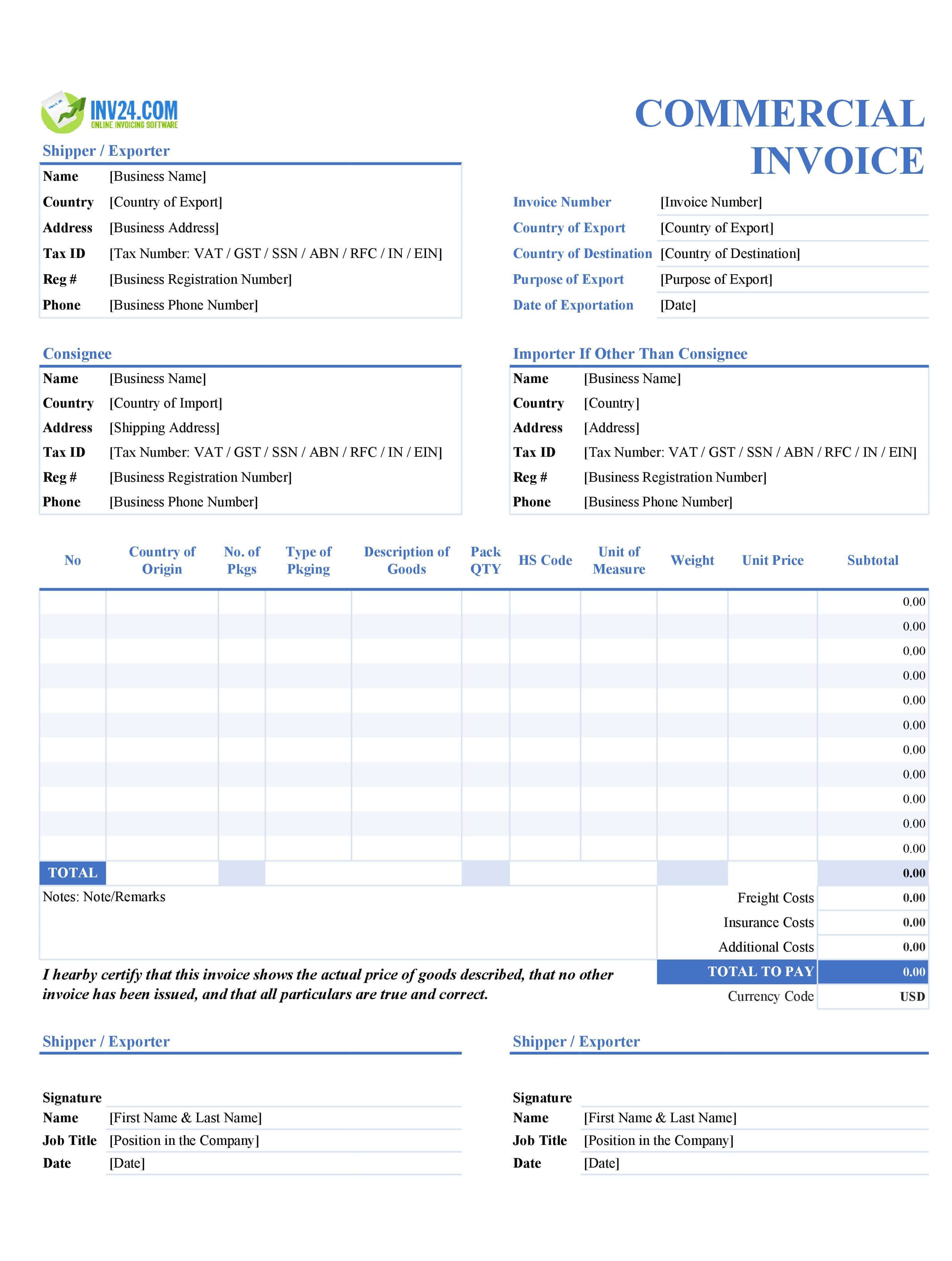
Free Commercial Invoice Templates
- Excel Commercial Invoice Template
- Word Commercial Invoice Template
- PDF Commercial Invoice Template
- Commercial Proforma Invoice Template
Essential Customs Document
Customs officials use the content of commercial invoices in order to ensure the smooth execution of trade. As an example, the product description helps allocate applicable tax codes and duties. Also the product description in the commercial invoices is compared with other trade documents such as the packing list, to ascertain the accuracy of the overall export/import process. Since the total invoice value is used to calculate tax and import duty, it carries significant importance as no export or import is able to take place without it.
Essential Accounting and Tax Document
A commercial invoice is an accounting document for exporters and importers. Exporters use the commercial invoices to record sales and pay taxes based on earned profit. On the other hand, importers record purchases and receive tax deductions for the payments made. It is important to note that the importer, or buyer is required to pay import duty which varies depending on products, countries as well as other factors.
Helps in Accuracy and Audit
A commercial invoice is a document that auditors can assess to help verify the accuracy of the overall export and import function. This is a favorite area for auditors to assess and verify purchase history, financial details and also to assess the efficiency of the purchase function. To explain, auditors verify purchase transactions by vouching and tracing commercial invoices with the purchase ledger.
Bank Requirement When Paying via a Letter of Credit
If the mode of payment is a letter of credit, the importer is required to submit the commercial invoice to the bank in order to release the payment for the seller (exporter).
Acts as a Basis to Resolve Disputes
A commercial invoice contains essential information that are related to trade including, product description, quantity and price. Since these contents are legally binding, the commercial invoice can be produced if there are any disputes regarding incorrect product shipment, price or quantity.
Helps in Risk Management
With international trade, there are various risks that can occur. For example, risks regarding duty/tariff, incorrect documentation, shipping accidents and customs delays and disruptions may eventuate. To manage these risks, a commercial invoice needs to be accurately drafted. For example, accurate product description and price can help to correctly apply and calculate the duty or tariff. The product value of the commercial invoice can be used to obtain insurance coverage and an overall error free commercial invoice helps to avoid any customs delay or disruptions.
Requirement to Insure Shipment
The premium of goods shipping insurance depends on the value of the goods that are transferred from the port of origin to the port of destination. A commercial invoice can be used here, as it is considered an authentic document that quotes the shipment value and premium.
Acts As Proof of Sale
A commercial invoice is generated in the buyer’s name when the sale is executed. So, it will act as proof of sale with the added confirmation that the person or business with the name on the commercial invoice will be considered as having the right to receive the shipment.
- A commercial invoice is used to request payment from a customer just like a normal invoice but it has the added complexity that is used in international or cross-border trade when the seller and customer are based in different countries.
- By providing authentic and accurate data, it helps in the goods clearance process at the port of origin as well as in the port of destination.
- It can be used by customs authorities to assess the value of goods that are exported or imported. It also helps to appropriately apply tax codes and also calculate the tax accordingly.
- Importers use the commercial invoice to support the imported goods value. Auditors may vouch for the commercial invoices in order to verify the accuracy and completeness of the purchase ledger. In addition, auditors can use commercial invoices as audit evidence to verify the existence and ownership of goods recorded in the audit client’s financial statements.
- In the case of a tax audit, a commercial invoice is used as support for the verification of deductible tax expenses. This expense may be via the cost of sales or other operating expenses.
- A commercial invoice helps to verify the product quality scale. It is simple to track product models, quality, and scale just by referring to the product descriptions on the invoice.
- Exporter or seller details such as their name, address, contact number, and tax details/ID.
- Importer, or the buyer details such as their name, address, and contact number.
- The mode of goods transportation which could be road or land, sea, rail, air and so forth.
- Bulk type of the shipment. This could be a full container, less than container or break bulk and so forth.
- Details of the vessel, such as the name and voyage number, which can be obtained from the shipping company.
- Details of shipment ports, including port of dispatch, discharge, and destination.
- Details of the product. This would include detailed description, unit price, unit weight, gross shipment weight, net shipment weight, and harmonized code (HS code).
- Invoice essentials such as date of invoice and number.
- Currency code, total goods value (declared value), total invoice value/payment, freight charges, insurance charges, declaration, shipping company title, their signatures with stamp, type of export, reason of export, terms of trade (Incoterms), and other charges applicable to export activity.
- There is the option to fill in optional fields like insurance cover policy number, letter of credit number, and bill of lading number.
Commercial Proforma Invoice
A commercial proforma invoice is a preliminary invoice that is issued by an exporter. It helps to build a trade understanding with an importer. It also contains standard content such as product description, price, quantity and so forth. It can also be modified at the request of the importer.
By issuing a commercial proforma invoice, the seller communicates that the terms and conditions mentioned in the invoice will be reflected in the final invoice. With that being said, the terms and conditions might change as a result of further negotiation.
In addition, importers can use a commercial proforma invoice in preparation for import. This preparation can be in terms of arrangement for payment, transportation, goods storage and others.
However, since a commercial proforma invoice is not a legally binding document, it is not sufficient for customs clearance or port formalities. There is often confusion about whether the commercial proforma invoice is just another way of using a commercial invoice. This is because the content and details of both invoices remain the same, however, the purpose or intention of creating the two invoices are different.
Commercial Proforma Invoice vs. Commercial Invoice
Commercial Proforma Invoice Commercial Invoice A commercial proforma invoice is issued in the preliminary stage of trade. It is designed to build an understanding between the exporter and importer for the terms and conditions of the trade. A commercial invoice is issued to request payment for the goods exported. It is not legally binding and may be subject to further negotiation. It is legally binding and is not subject to further negotiation. It is issued before goods are delivered and is insufficient for customs clearance. It is issued with the goods and contains important aspects that help to apply and calculate import duty/taxes. Standard Format Commercial Invoice
A standard format commercial invoice is frequently used when the customs authority of the importing country has no specific requirements. In this case, the standard format commercial invoice requires content such as product description, price, quantity, invoice number, invoice date and other essential details related to the shipment.
A Commercial Invoice With a Declaration
This type of commercial invoice is one where a formal statement or declaration is included. This declaration can be in terms of value, quantity, weight, payment terms, insurance, country of origin, conformity as well as others. The purpose of the declaration is to provide and confirm the requested additional information. This requirement can be from the customs of the importing countries and even the exporting one. It is important to take note of the requirements of the relevant port when initiating the process of export or import as different countries may require different declarations.
Consular Invoice
A consular invoice refers to a commercial invoice where the content and details are certified by the consul in the country of destination. It can be thought of as an authorization from the country of a buyer to allow the import of the specified goods on the terms mentioned in the invoice.
The content and details may include, details for consignor, consignee and shipment value. It helps the importer’s country in price scrutiny and also protects their market from imports that create dumping. Dumping is when the seller exports products at a price which is lower than the cost in the home country in order to capture the foreign or importing market. This is more common in the case of related parties.
Landed Cost Invoice
A landed cost invoice contains the complete cost that it takes to import the product. It includes the cost of the product, the cost or transportation (all types including overseas and inland), the cost of insurance, the cost of tariffs, taxes, duties, goods handling, port charges, payment charges and any other cost or overhead associated with the import of the product. This type of invoice is important as it helps the importer to determine the appropriate selling price with the desired profit margin.
Custom-Purpose Commercial Invoice
The custom-purpose commercial invoice refers to a commercial invoice where the content or details of the commercial invoice are modified in line with the requirements of the customs authority. It helps by giving the required information while speeding up the clearance process at the selling port and the buying country.
Consolidated Commercial Invoice
A consolidated commercial invoice is issued when multiple transactions and shipments are cleared via a single invoice. This technique is applied when multiple small shipments are exported to the same destination, but can be from different suppliers to be delivered to different customers. The purpose of consolidating or combining different invoices is to enhance customs clearance efficiently. This is done by reducing paperwork and this also saves energy, time as well as money.
- Name of the item packed
- Quantity of the products
- Weight of the shipment (Gross and Net)
- Dimensions of the packs (height, length and width)
- Cubic volume
- Count of the cartons or packs
- Detailed description of the goods
- Packing information such as crates, boxes, pallets, etc
- Nature of the product such as solids, liquids etc
- Volume of the product
- Commercial invoice number
- Exporter’s identity
- Identity of the buyer
- Packing number
- Date of packing
- Place of the issue of the packing list
- Number of pages in the packing list
Disruption in Customs Clearance
An inaccurate commercial invoice can delay customs clearance and lead to investigations. If there are different quantities of products in the packing list and the commercial invoice, customs may notice this discrepancy and this will lead to further scrutiny and requirements for additional information. This situation will mostly likely lead to delayed shipment clearance which can cause customer dissatisfaction and even penalties from the tax authorities.
Penalties From Customs Authorities
Customs officials use the commercial invoice to assess tax codes and apply duties. This means that if there are any errors or omissions on the invoice, then this will lead to inaccurate tax assessment which will inevitably result in further investigation and penalties.
Dispute With Customer
Errors or omissions on the commercial invoice may lead to disputes with the cross-border customer. If things are not handled properly, there may be an impairment in the customer working relations with the seller.
- One copy is forwarded to the country of origin.
- One copy is forwarded to the country that the goods are being shipped to.
- One copy is sent to the customer that the goods are sold to.
Why is a Commercial Invoice an Important Document in International Trade?
What is the Purpose of a Commercial Invoice
Following are the main purposes that a commercial invoice is designed to achieve:
Requirements for a Commercial Invoice
Following are the standard requirements of a commercial invoice:
We have just discussed the standard details of commercial invoices. However, there can also be different types of invoices depending on the intended purpose.
Types of Commercial Invoices
There are different types of commercial invoices that serve different purposes. The importer may request different types of invoices depending on the country’s customs requirements.
Next will be a discussion on the types of commercial invoices from the perspective of import and export:
What are the Terms of Sale on Commercial Invoices (Incoterms)
The terms that are detailed on the commercial invoice are called “Incoterms". These are eleven standard terms issued by the International Chamber of Commerce (ICC) which allocates exporter and importer responsibilities in order to execute the trade process efficiently. These terms are listed in the contracts to highlight who should bear the risk and cost of shipment.
As mentioned, there are 11 incoterms in which four are specifically for the sea and inland waterway transit and seven are applicable to all modes of transportation.
7 Incoterms for All Modes of Transport
| Trade Terms / Rules | Meaning |
| Ex Works (EXW) (Place of delivery) | The seller must dispose of the goods from their premises (warehouse, factory, office etc). They are not even required to load goods in the vehicle. The buyer bears all the risks and costs once the goods are out of the seller's premises. It is the most desirable trade term from a seller's perspective. |
| Free Carrier (FCA) (named Place of delivery) | The seller needs to deliver the goods to the carrier's place (nominated by the buyer). It may be the carrier's warehouse, port, airport, or other place. At this point, the seller is free from responsibility, and the buyers assume all the risks and costs. |
| Carriage Paid To (CPT) (Place of destination) | The seller must pay the freight cost, including export fees and taxes in the country of origin, and deliver goods at a mutually agreed destination (importing country). However, the seller's risk is limited to transferring goods to the first carrier (maybe a truck). Once goods are loaded onto the truck, the seller's risk ends. They must meet expenses until delivery at a mutually agreed destination in the buyer’s country. |
| Carriage and Insurance Paid To (CIP) (Place of destination) | It is like CPT, but the seller is required to pay the insurance expenses for the transportation. |
| Delivered at Place (DAP) (Place of destination) | The seller bears the risk and costs until the goods are delivered at the destination port. However, import permits, the cost of unloading, and customs duties can be headaches for the buyer. |
| Delivered at Place Unloaded (DPU) (Place of destination) | The seller bears the risk and costs until the goods are delivered and unloaded at the destination port. However, customs clearance and duties are paid by the buyer. |
| Deliver Duty Paid (DDP) (Place of destination) | The seller is responsible for bearing all the costs and risks until the goods reach the agreed destination. The seller is responsible for paying customs duties and insurance costs. It is the most desirable term of trade from a buyer's perspective. |
Four Incoterms Specific to the Sea and Inland Waterway
| Trade Terms / Rules | Meaning |
| Free Alongside Ship (FAS) (port of loading) | The supplier is responsible for carrying goods to the buyer's vessel. The buyer assumes the risk and cost once goods have reached the vessel. The seller takes care of export customs. |
| Free on Board (FOB) (port of loading) | The seller is responsible for loading goods onto the vessel after clearing export customs. |
| Cost and Freight (CFR) | The seller bears the cost of vessel transportation. However, the seller does not presume the risk of damage once goods are loaded in the vessel at the port of origin. |
| Cost, Insurance and Freight (CIF) | It is the same as CFR, but the seller must obtain insurance coverage for the voyage. |
In order to avoid any confusion or misunderstanding gap, these incoterms need to be in the contract and mutually agreed upon between the seller and buyer. There must not be any gap in the commercial invoice. Which brings us to the next question.
Commercial Invoice and Packing List
A commercial invoice is more about the value of the goods exported or imported. A packing list, however, is used to provide shipment details. These details include the following:
The details and quantity on the packing list should be the same as on the commercial invoice. Any difference between these two may lead to delayed customs clearance which in turn leads to serious issues with the goods delivery. In addition, both the exporter and importer need to comply with the terms of trade.
What Happens if a Commercial Invoice is Wrong?
Generally, the following risks are associated with mistakes in commercial invoices:
What is a Commercial Invoice's Header, Country of Origin, and Currency Code?
Header
This is the most noticeable part of the invoice. It has the words, “Commercial Invoice” and enables the reader of the invoice to quickly understand what type of document it is.
Country of Origin
This is the country from where the goods originated. In other words, it is the seller’s country.
Currency Code
This is a three letter code that specifies the transaction’s currency. For example, USD, GBP, EUR, CAD and so forth are written on the invoice.
What is Customs Clearance / Import / Export?
Customs Clearance
This is basically the legal process of importing or exporting goods. During this process, the customs authority reviews the purchase and sales shipping documents, such as commercial invoices, packing lists, tariff classifications and declarations in order to assess the accuracy and valuation of the shipment. The shipment accuracy is mandatory as it enables the customs or import duties to be reached. To ensure a smooth export and import process, a set procedure for documentation and assessment should be followed.
Export
The process of export is when goods are dispatched to another country via a border.
Import
When goods are received from another country via a border, this process is known as import.
It is of particular importance that the documentation needs to be accurate and complete in order for customs clearance at both the exporting and importing ports. This shows the importance of the commercial invoice and that it must not be underestimated.
What is an Undervalued Commercial Invoice, and What Can be the Motive Behind an Undervalued Commercial Invoice?
A commercial invoice is considered undervalued when the declared value of goods is less than the actual value. The motive for this is, that in international trade, this practice is used attract lower import duties. As we understand, the tax rate is applied to the value of goods mentioned in the commercial invoice. So, if the value of goods is lowered intentionally, this will lead to a lower tax liability. Not to mention, extensive scrutiny is made for a high value shipment. So, in this regard, an undervalued commercial invoice may be used as a tool to avoid scrutiny or attract attention.
What is the Difference Between an Invoice and a Commercial Invoice?
The following table outlines the main differences between invoices and commercial invoices.
| Invoice | Commercial Invoice |
| A seller issues an invoice to request payment for the goods delivered to the customer. | A seller issues a commercial invoice to request payment for the goods delivered to the customer. However, it is used in the case of international trade. |
| The content or details are limited in comparison to commercial invoices. | A commercial invoice contains more content or information than a normal invoice. For instance, it may include the country of origin, country of destination, incoterms and much more. |
| The amount on an invoice is used to make VAT/GST payments and pay bills. | The amount or value in the commercial invoice is used to calculate import duties and taxes. Further, the amount in a commercial invoice is equally important as it is referred to in order to pay the supplier for goods delivered. |
| An invoice can be for the services rendered or products delivered as well. | A commercial invoice is associated with the export or import of goods in the international market. |
Conclusion
A commercial invoice is a legally binding document that is used in international trade. It is considered an essential document when goods cross the border. Customs officials use this document to obtain the value of the goods, apply the appropriate taxation code and also to calculate the customs duty to be applied to the shipment.
Stakeholders, including the government of the exporting country, the government of the importing country and the buyer, all use the commercial invoice. This invoice is generated by the exporter (or seller or consignor) and needs to have a unique and sequenced invoice number so that it can be tracked and managed easily.
Detailed information and content are required to generate a commercial invoice. These include, the name of seller and buyer, contact details and addresses, invoice date, invoice number, product description, HS code, decided incoterm, product price, product quantity, port of origin, and port of destination as well as others.
There are different types of commercial invoices, including proforma, standard format, customs invoices, commercial invoices with declarations, consular invoices and so forth.
A commercial proforma invoice is not legally binding. Rather, it is a preliminary invoice that is used to negotiate terms of trade. This also makes it subject to negotiation. This means that it is insufficient for goods clearance purposes at the ports.
A commercial invoice will need to be signed and stamped by the seller or exporter. If the product is exported as a gift or sample, the invoice can have a zero value. However, this must clearly be stated on the invoice.
Terms of trade must be mentioned on the invoice and also needs to be mentioned in the contract. Both exporter and importer must agree on these terms. The eleven terms from the international Chamber of Commerce sets the responsibilities of the exporters and importers in the trade process.
In order to ensure smooth international trade, the exporter needs to accurately generate the invoices as any gaps or errors in the invoice can lead to significant problems as well as delays in the trade.
Frequently Asked Questions
Who should provide the commercial invoice?
The shipper, exporter or consignor is the party that provides the commercial invoice. It can be thought of as the same as a normal invoice, where the seller requests payment from the buyer for the goods delivered. However, the difference is that the commercial invoice is only used in international trade. To note, the seller is responsible for ensuring that the accurate invoice information such as product description, quantity and price is correct. If there is any error on the invoice, this may lead to delayed shipment.
Do commercial invoices need to be signed?
A commercial invoice needs to be signed by the exporter or consignor. The signature represents that the signing authority has reviewed the content and details of the invoice and also serves as a declaration that the information provided is true and fair, to the best of their knowledge.
In this way, the signatures on the commercial invoice leads to enhanced authenticity, and reliability of the invoice’s content such as description, price, and quantity. This is because the relevant official has reviewed and signed the invoice.
Of importance, is that the authority signing the commercial invoices must mention its designation as this can differ from business to business depending on the policies and internal structure.
It is important to note that the main purpose of the commercial invoice is to request payment and provide details for the value of the goods exported. For all details about the content of the shipment, another document, called the “Packing List” is used in international trade. Following will be a discussion on what a packing list is and how it differs from a commercial invoice.
Do payment terms need to be inserted on commercial invoices?
Yes, payment terms need to be inserted into the commercial invoice. The payment terms on the commercial invoices elaborate on how many days the customer has to pay the invoice. More commonly, net 30 is used as the payment term. This means that the customer or buyer has 30 days to pay the invoice once it has been received.
Should a commercial invoice include freight?
Yes, freight charges on custom invoices should be included on the commercial invoice. In fact, this is one of the more essential components of commercial invoices.
Is a commercial invoice also known as a customs invoice?
They are not exactly the same, and there is in fact a small difference between a standard commercial invoice and a customs invoice. The customs invoice is used for the clearance of higher valued shipments whereas a commercial invoice is used by relatively smaller merchants that export goods.
How many copies of a commercial invoice are required?
Three copies of commercial invoices are required to address the following three stakeholders:
What should be the date format on a commercial invoice?
This date format feature can be a source of confusion as different countries use different formats. As an example, in the USA, the date format used is MM/DD/YYY. In other countries, such as the UK, the date format is DD/MM/YYYY. Even though any format can be used, it is confusing if exporting and importing countries use different date formats. To avoid this confusion, it is a good idea to be more clear by writing dates that avoid any ambiguity. For instance, a date could be written as, “1. Jul. 2024”.
Do I need a commercial invoice for services?
The short answer is “no”. Since services do not require cross-border movement that goods do, this means that services do not require a commercial invoice, for clearance purposes.
Who is responsible if there is an error on the commercial invoice?
It is the responsibility of the shipper, consignor or exporter to ensure that the commercial invoices are error-free. This is because the invoice is generated by the seller and is used by the government to apply tax rates and calculate tax liabilities.
What is included in the commercial invoice for return?
The commercial invoice for the return should include the reason for the return, the replacement value of goods returned as well as the HS codes for the products being transported for the return. Customs do not charge duties or taxes for the returns. Nevertheless, the consignor or exporter must be able to state that the shipment is for return purposes and must have no malicious intention to avoid taxes.
Should a commercial invoice include VAT/GST?
The answer is “no”, the VAT or GST are not included in the commercial invoice. However, the customs officials refer to the goods value in the invoice to calculate duty and taxes.
Can a commercial invoice have a zero value?
Yes, the value of the invoice can be zero if the product is exported or imported as a sample, gift or for testing. The commercial invoice can have zero value but needs to be endorsed on the invoice that “these are samples, free of cost,” or a “gift” . Usually, duty is not applied to the samples. Despite this, if the import samples are in a large quantity, it could be subject to investigation.
Where does the commercial invoice go on the package?
A commercial invoice that is inside the package is kept for the customer. The customer then receives it at the time of receiving the shipment.
Do commercial invoices need to be in the English language?
Yes, commercial invoices are strictly to be in the English language only.
Who issues commercial invoices?
A commercial invoice is issued by the exporter, seller or consignor. It must accurately reflect the product description, value, quantity, incoterm and other pertinent information required in the import/export business.What is the HS code on the commercial invoice?
Harmonized or HS code is a standard numerical product classification method in the commercial invoice. This is used by the customs authorities to assess duties and taxes applicable to the shipment.
Can a commercial proforma invoice be used as a commercial invoice?
The answer is “no”. Since a commercial proforma invoice is a preliminary invoice which is subject to negotiation, it is not considered to be sufficient to be used as a commercial invoice. In addition, it is not a legally binding document. Hence, it cannot be used as a commercial invoice.
Which currency can be used to write amounts on the commercial invoice?
The decision to use a certain currency on a commercial invoice is based on the agreement between the exporter and importer. To avoid any potential disputes, it is better to negotiate and document the transaction currency in the preliminary stages of the deal.
Are commercial invoices legally binding?
Yes, a commercial invoice is a legally binding document. It shows that the seller is responsible for delivering the goods in the same scale as mentioned on the invoice. It also serves as a formal document to request payment as well as being required for the customs clearance process.
Can a commercial invoice be used for payment?
A commercial invoice is a formal request for payment in International trade. So, “yes” it can be used to make payments. Further, it is used by customs authorities to calculate import duties and taxes. It is important to note that the components of the commercial invoice are legally binding.
How do you define commercial invoice numbers?
The commercial invoice number must be unique and sequenced for each invoice. The invoice number helps to locate and track the invoice for both the seller and buyer. It can also be used for referencing other documents as well as being important for customs compliance.
CREATE INVOICE ONLINE
Invoicing Tools: